Keno offered by an offshore casino does not become Australian-regulated simply because it is labelled keno.
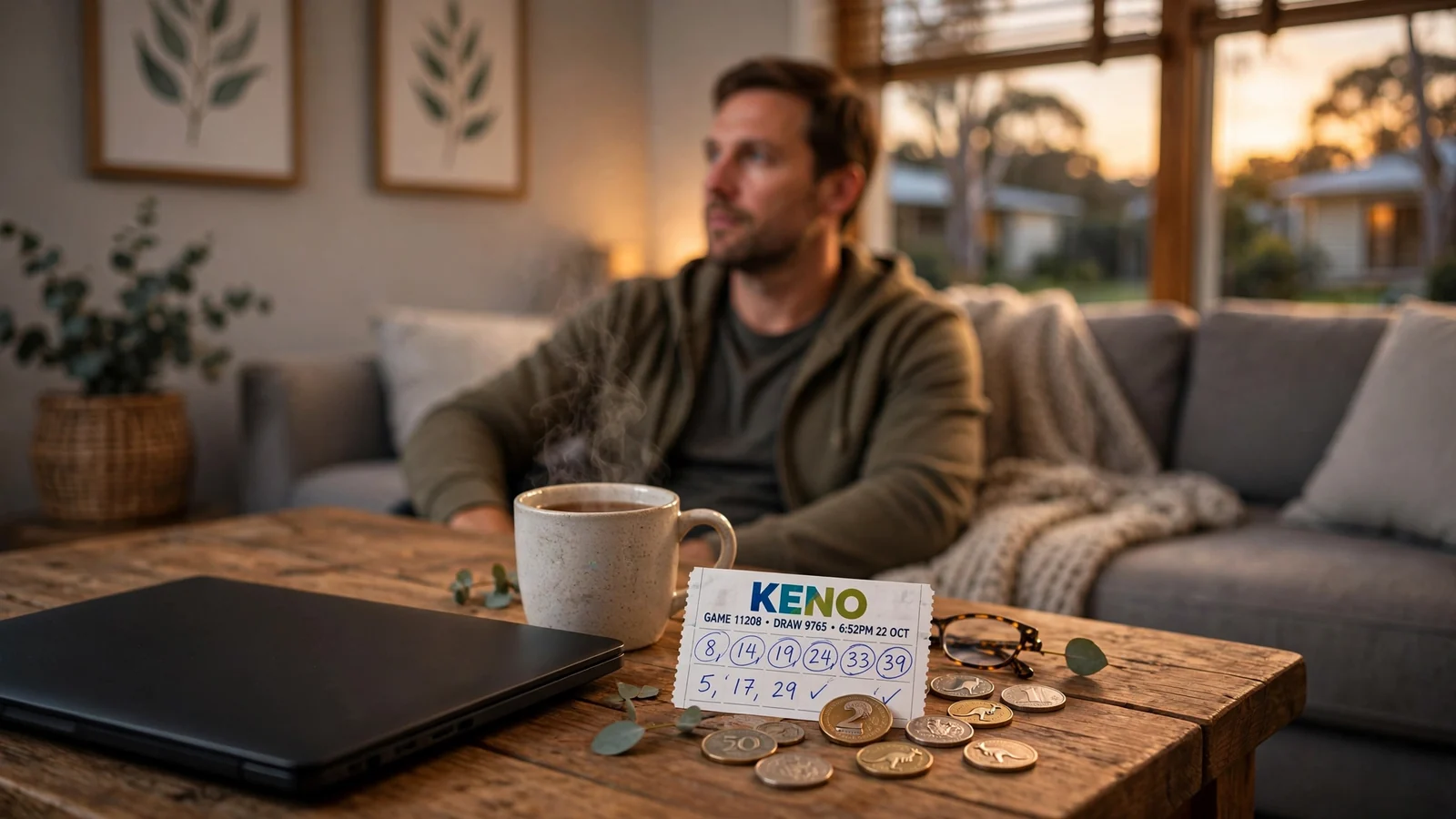
Australia has no domestic licence for online casinos. Under the Interactive Gambling Act 2001, operators cannot legally provide real-money online casino games to people in Australia without a local licence, and none has been issued. The restriction is directed at the businesses offering the service, rather than making an individual player liable simply for attempting to access an offshore site.
That distinction matters, but it does not make an offshore casino an Australian-regulated option. A site may appear in front of you, use familiar language or claim to serve Australian customers; none of those things creates a domestic licence or places its conduct under Australian casino regulation. A keno game offered as part of an online casino should be considered in that same setting: the service is not an Australian-licensed casino just because the game is called keno.
The key point is the operator’s location and the law that applies to its offer, not the wording on a page. For real-money casino-style games, the Australian framework prohibits supply to people physically in the country. There is no locally licensed online casino for you to compare against an offshore one, and no Australian casino licence that an offshore operator can show as proof of domestic authorisation.
Keno availability and the terms that matter can vary by casino, so use this list as a starting point and check the details before you play. The notes below stick to the information available for each operator.
SpinsUp
SpinsUp lists a Curaçao Gaming Control Board licence, OGL/2023/174/0082, held by Dama N.V. This gives you a specific licensing detail to check when assessing the casino.
WinSpirit Casino
WinSpirit Casino lists a Curaçao eGaming licence, OGL/2024/923/0383, held by Antillephone N.V. Its stated minimum deposit is A$30.
LuckyVibe
LuckyVibe lists a Curaçao Gaming Control Board licence, OGL/2023/176/0095, held by Hollycorn N.V. The available details provide a specific licensing point for your checks.
GoldenCrown
GoldenCrown lists a Curaçao Gaming Control Board licence, OGL/2023/176/0095, held by Hollycorn N.V. You can use those details to check its stated licensing.
MrPacho
MrPacho lists crypto payouts at 30–120 minutes and fiat payouts at 24–72 hours. The stated minimum deposit is A$30.
Ricky Casino
Ricky Casino lists crypto payouts in under an hour and PayID payouts in 1–3 business days. Its minimum deposit is A$20, or A$30 to qualify for the bonus.
Golden Pokies
Golden Pokies lists a Curaçao licence. Beyond that licensing detail, the available information does not provide specific features to assess.
Wild Tokyo
Wild Tokyo lists a Curaçao licence, crypto payouts at 30–60 minutes, and fiat payouts at 1–5 days. Its stated minimum deposit is A$10.
Bizzo Casino
Bizzo Casino lists a Curaçao Gaming Control Board licence, with TechSolutions Group N.V. named. This is the available licensing detail for your checks.
DragonSlots Casino
DragonSlots Casino lists a Curaçao Gaming Authority licence, with Jumpman Gaming Ltd named. The available information does not specify other features.
The Australian Communications and Media Authority (ACMA) is the main domestic regulator responsible for enforcing the Interactive Gambling Act. Its role includes restricting access to illegal offshore gambling services. ACMA maintains a blocklist, and Australian internet service providers are required to comply with it.
This means an offshore service can become inaccessible through an Australian connection, even if it was previously visible. A site’s appearance in search results, or the fact that a page loads at one moment, is not evidence that ACMA has approved it. Nor does a block necessarily tell you everything about an operator’s status: it is a practical enforcement measure, not a quality rating or a consumer endorsement.
Access restrictions also make the online landscape changeable. A domain may stop loading, redirect elsewhere or be replaced by another address. Those changes do not create a dependable route to an Australian-licensed service. If a site presents itself as locally approved, look for what that claim means in legal terms rather than taking Australian branding, currency or customer support as proof.
It can be reassuring to learn that the Act targets operators, not individual customers. That is a useful distinction when understanding who the law is designed to regulate. It should not be mistaken for a recommendation to use an offshore casino or a guarantee that an Australian authority can resolve a dispute with one.
An operator outside the Australian licensing system is not brought under domestic casino oversight simply because it accepts Australian visitors. The absence of a local licence also means you should not read the site’s own claims as equivalent to Australian authorisation. The law’s focus on operators does not remove the practical uncertainty attached to dealing with a service beyond the domestic regulatory framework.
The same caution applies when a site describes itself as one of the best places for online keno in Australia. That phrase is promotional, not a legal status. It does not show that the operator is authorised to supply real-money casino games here, and it does not mean ACMA has assessed or endorsed the service. Do not treat prominence, polished presentation or a familiar game label as substitutes for domestic approval.
A measured approach starts with the boundary: real-money online casino services are not licensed in Australia, and ACMA acts against illegal offshore services, including by blocking access. The fact that the law is aimed at operators rather than players does not turn offshore access into a protected Australian service. If a keno casino is operating from overseas, its presence does not change the rules governing supply to people in Australia.
So, when considering a real-money online casino that offers keno, keep the legal position separate from the operator’s own assurances. Australia has no licensed online casino, and a foreign site cannot become locally authorised through its wording or availability. ACMA’s blocking role is another reason that apparent access should not be confused with approval. That is the essential context for assessing what an offshore service can—and cannot—represent to an Australian reader.
An offshore casino may appear accessible and may accept an Australian customer, but that does not give you the protections or practical remedies available through an Australian-licensed service. If a dispute arises, the operator is based outside Australia and your relationship with it is governed by circumstances that may be difficult to challenge from here. A site’s willingness to take a customer does not establish that it will resolve a complaint fairly.
The most serious exposure is straightforward: if an offshore casino refuses to pay winnings, Australian players have no legal recourse in Australia. You cannot rely on Australian authorities or courts to make the operator release the money. That matters whether the disagreement concerns a balance, a result, or the operator’s interpretation of its own terms. A displayed account balance is not the same as money you have received, and a customer-service exchange is not a guarantee of payment.
Before risking money, consider what would happen if the operator disputed your claim. You might be asked to communicate with a business in another jurisdiction, under terms you accepted online. Even if you believe the operator has acted improperly, pursuing the matter from Australia may be difficult, and there is no local casino regulator that can step in as your representative. The practical burden of resolving the dispute can fall on you, while the operator controls access to the account and its records.
That imbalance can be hard to assess before a problem occurs. A polished website, responsive support or a prominent description of its rules does not create an Australian remedy. Nor does a method of depositing or withdrawing establish that an operator is licensed here, that your balance is protected, or that a complaint will be decided in your favour. Keep those issues separate: accepting Australian customers is not proof of accountability to Australian institutions.
Access itself can also be uncertain. ACMA blocks illegal offshore gambling sites, and internet service providers must comply with its blocklist. A service that you can reach today may not remain accessible in the same way. A change in access does not resolve an existing payment dispute or provide a route to recover money. If you are weighing whether to play for real money, include the possibility of losing access to the service and having no Australian legal remedy if the operator withholds winnings.
BetStop has a narrower role than some people may assume. It applies to Australian-licensed operators and does not bind offshore sites. Because there is no Australian-licensed online casino, you should not treat BetStop as a safeguard that will control an offshore casino account or prevent that service from accepting you. If you use BetStop in relation to services it covers, that does not extend its effect to a foreign operator.
This distinction is important when you are trying to reduce your exposure. A tool that works within Australia’s licensed gambling system cannot be assumed to reach a business operating offshore. Do not infer that a site will respect a request to stop, close an account or restrict access merely because you have taken steps with BetStop. Its protections do not give you a way to compel an offshore casino to follow them.
If a site accepts you, pause before treating that acceptance as reassurance. Ask yourself whether you could tolerate having no Australian legal route if a withdrawal were refused. If the answer is no, that is a material risk, not a minor inconvenience. The key question is not simply whether you can open an account or place a bet; it is what support remains available to you when the operator and you disagree.
For real-money play, the limits of local recourse should be clear before you act. An offshore operator’s claims, terms and customer support may influence how it handles a complaint, but they do not give you the protection of an Australian-licensed online casino. If winnings are withheld, Australian players have no legal recourse in Australia.
Words used to describe keno online can blur together, even when they point to different ideas. Someone may mean a standalone keno game, a casino-style service that lists keno, or a game whose name combines keno with pokies terminology. The wording alone cannot tell you which one is meant.
That distinction matters when a page refers to “keno pokies” or “keno slots”. Those phrases may describe a theme, a category label or simply a mixture of terms. They do not establish that a particular game exists on a service, that it can be accessed from Australia, or that the service is appropriate for Australian players. A familiar phrase is not evidence of what is actually offered.
The same caution applies to references to online casinos with keno. A site may use casino language in its description, but the label does not confirm that keno is available there. Nor does the word “live” confirm that a real-time keno product exists or explain how it works. Descriptions need to be assessed as claims, rather than treated as proof.
A page described as a guide to the best keno casino sites may sound like a comparison, but the wording itself supplies no basis for a ranking. It does not show what has been assessed, whether the information is current, or whether any service named is suitable for people in Australia. A list presented as “top” choices is still only a list unless its claims can be checked.
This is especially important when several labels are used interchangeably. A page might mention keno, pokies and a casino in the same paragraph without making clear whether it means one game, separate games, or a broad category. Do not infer that a keno title is available simply because the page contains several related terms. Look for a precise description of the service and the game, and treat vague wording as inconclusive.
Even a specific-sounding phrase, such as a casino offering keno, does not settle the question of availability. A search result or page heading may summarise a site in broad language; it is not a confirmation of what a person located in Australia can access. The same goes for references to live keno: the wording does not, by itself, verify that a live offering is present.
A reference to Bitcoin alongside keno is another example of labels that can be placed together without proving the underlying details. It does not confirm that a service accepts Bitcoin, that keno is among its games, or that the two are available to Australian users. Treat payment wording and game descriptions as separate claims; one does not authenticate the other.
Likewise, the phrase “online keno” may be used broadly, without identifying the rules, format or actual availability of a particular game. A page that combines several terms may be trying to capture different meanings rather than describe one verified product. If it does not explain what it means, the sensible interpretation is that the wording is unclear—not that every interpretation is true.
When you encounter a keno-related casino description, separate three questions: what game is being referred to, what service is being described, and whether the claim applies to someone in Australia. A page may answer one while leaving the others unclear. The name alone cannot fill those gaps.
This is not a reason to assume that every mention is false. It is a reason not to treat naming as confirmation. “Keno” in a heading does not prove that a playable game is present; “casino” does not verify that the service is suitable for Australians; and words associated with pokies do not establish that the page is describing a distinct keno product.
Keep those meanings apart when reading. Search phrases can combine familiar terms in ways that sound specific but leave the important details unresolved. A clear description is more informative than a crowded label, and where the description does not say what is offered or to whom, do not fill in the blanks yourself.
A game’s name or presentation tells you little about the safeguards around the service offering it. Before you consider using an online keno service, look at the practical questions that affect your safety: whether you meet the age requirement, what identity checks may be requested, and whether you can set limits or stop access.
In Australia, the legal age for gambling is 18. That applies to online gambling as well as gambling in other settings. If you are under 18, do not register or try to use a gambling service. A service’s willingness to let someone create an account is not a reason to disregard the age requirement.
If you are an adult, still read the service’s account conditions before providing personal information. Make sure you understand what information it asks for and how it says that information will be handled. Avoid sending identity documents through a channel that the service has not identified as an appropriate verification method.
Identity checks can affect whether you can withdraw funds, so do not leave them until you are trying to access a balance. A specialist review reports that some casinos request verification before a first withdrawal. The documents described can include a photograph of your identification and proof of address; a selfie holding your identification may also be requested.
Before depositing, read the operator’s terms to find out which documents it may ask for, how to submit them, and whether the name and address on your account must match your documents. If anything is unclear, ask the operator for an explanation before you provide documents or funds. Keep copies of what you submit and any replies you receive. These steps do not guarantee a particular outcome; they help you understand the process before it becomes urgent.
Responsible-gambling tools are most useful when you can find and understand them before you need them. Check whether the service offers deposit limits, loss limits and session time limits, and whether you can choose settings that suit your circumstances. Look for self-exclusion options as well. These are established harm-minimisation tools, but their presence alone does not tell you how promptly or effectively a particular operator applies them.
Read the instructions for changing a limit or activating self-exclusion. Find out whether a limit takes effect straight away, whether a change can be delayed, and how exclusion applies to your account. If the terms are difficult to find or explain only how to increase activity, treat that as a reason to pause rather than assume the controls will work as you expect.
BetStop is a self-exclusion service for Australian-licensed operators. It does not bind offshore sites, so registering with BetStop should not be treated as a way to block access to every online gambling service.
A keno game’s format does not replace these checks. Whether you are looking at a single game or an app, review the account, verification and safety information before you engage. Do not rely on a button or label that merely says “responsible gambling”; look for specific tools and clear instructions.
If you cannot confirm the age rules, understand what identity material may be requested, or locate the available limits and exclusion process, do not proceed until those points are clear. And if you feel that gambling is becoming difficult to control, use support and exclusion options rather than trying to manage the concern by continuing to play.
When keno is described with slot-machine language, the wording can blur two different kinds of game. A comparison may be intended to describe a visual style or a way of presenting play, but it does not establish how a particular keno game works. Nor does it show that a service offering it is suitable for you. Treat labels that combine keno and pokie terms as descriptions to examine, not as proof of a shared format.
Information about pokies also needs to be read on its own terms. A specialist review reports that some providers let casinos choose from multiple return-to-player (RTP) settings for a particular pokie. The same title may therefore have different stated return percentages at different casinos. That detail applies to the pokie discussed; it is not evidence about keno, and it should not be transferred to a keno game simply because the wording groups them together.
A stated RTP is not a prediction of what you will receive in an individual session. For pokies, each spin is an independent event determined by a Random Number Generator. A previous result does not make a particular result due next, and a run of outcomes does not demonstrate that the next spin will behave differently. This explains why a strategy built around past spins cannot be inferred from the game’s label or from comparisons with keno.
The same care applies when descriptions mention a “strategy” for a keno-style pokie. A phrase like that does not establish that a method changes the outcome, improves returns or applies across different games. The mechanics and settings would need to be identified before any comparison could be meaningful. Avoid reading confidence into a promotional description when it does not explain what is being compared.
If you are checking a game description, separate claims about its name, appearance and category from claims about its mechanics. Confirm what game the statement actually refers to, and whether its RTP information is specific to that title and setting. Do not assume that information about a pokie carries over to keno, or that a shared label makes the games interchangeable.
That distinction matters because broad wording can make unlike games seem equivalent. A comparison is useful only when it is precise about the game and the feature being compared. If it is not, the safest reading is simply that the wording is ambiguous—not that it tells you how keno works or what outcome to expect.
A free-play label can sound straightforward, but it does not tell you what is actually available. A page describing keno in slot-style terms may refer to a demo, a promotional description or something else entirely. The wording alone does not confirm that you can play a free keno game, how it works, or what conditions apply.
Treat “free” and “demo” as labels to clarify, not as proof of a particular experience. Before relying on the claim, look for a clear explanation of whether the game can be played without depositing money, whether access is limited, and whether any terms apply. If those details are absent or unclear, you cannot safely infer them from the heading or a short description.
The same care applies to claims about playing keno online without paying. A free-to-play description does not establish whether the activity is available to Australian users, whether it uses the same game as a real-money offering, or whether it leads to an account or deposit prompt. Do not assume that a page’s wording answers these questions. If the distinction matters to you, check the terms attached to the specific experience rather than relying on a search-result summary.
Free play and real-money gambling are different claims. A demo label does not show that a game is suitable for real-money play, and information about real-money services cannot be transferred automatically to a free version. Conversely, calling something free does not verify that there is no charge, condition or later invitation to deposit. Read what is stated about the particular activity and stop if the terms do not make the distinction clear.
That distinction matters especially when a description combines keno with slot-style language. The phrase may be used loosely, but it does not identify a verified game or prove that a particular service offers it. A polished page, an image of a game, or a prominent “play” button is not a substitute for clear terms explaining what you can access.
Keep your decision narrow: establish whether the offer is genuinely free, what participation involves, and whether any real-money element is attached. If the page leaves those points unanswered, regard the claim as unconfirmed rather than filling in the gaps yourself. That is more reliable than assuming that every free keno description represents the same kind of play.
A claimed keno strategy can sound persuasive when it is presented as a way to improve results. Treat that wording carefully. A description of number selection, patterns or timing is not proof that a method changes the outcome. Without reliable information about how a particular game works, there is no sound basis for assuming that a strategy gives you an advantage.
The same caution applies to claims about software. A label such as “keno software” does not tell you who made a game, how its results are generated or whether a particular service offers it. A site’s description may use technical language, but the wording alone cannot verify what is operating behind the screen. Avoid treating confident explanations as independent evidence.
It also helps to keep keno distinct from pokies, even when the names are combined in a game title or description. A pokie spin is determined by a random-number generator, so one spin does not predict the next. That fact concerns pokies; it does not establish how a keno game works, whether a strategy affects it or what software it uses.
There is also a detail about pokies that can complicate comparisons. A specialist review notes that some game providers let casinos choose between different return-to-player settings for a pokie. The same title could therefore have different settings in different venues. That information is specific to pokies and cannot be used to infer a keno game’s return or mechanics.
When assessing a claim, separate what it actually demonstrates from what it merely suggests. A provider name, a software label or a list of recommended numbers does not, by itself, confirm fairness, odds or suitability. Nor does an explanation of a pokie’s random outcomes establish anything about keno. Look for clear, game-specific information rather than assuming one category’s features carry over to another.
This distinction matters if you are comparing an online keno game with a keno-themed pokie. Similar wording can make two different formats sound interchangeable. It does not make their rules, software or outcomes the same. A strategy attached to one format should not be treated as relevant to the other without evidence tied to that exact game.
If a claim promises predictable results, consider what evidence would support it and whether that evidence is specific to the game being described. If the explanation relies only on patterns, software terminology or confident assurances, keep your expectations measured. The label may tell you how a service presents a game; it does not establish that a strategy works or that a particular system is in use.
A reference to Canada can make a keno result look more relevant than it is. It may describe an audience, a service’s intended market or simply wording chosen for a page. On its own, it tells you nothing reliable about whether the service is available to someone in Australia, what rules apply to it, or what protections you would have.
The same caution applies when a page pairs keno with a Canadian online casino. The country named in the description does not establish that the service is licensed for Australian customers, or that Canadian requirements govern a person using it from Australia. A location label is not a substitute for information about who operates a service and where it is permitted to provide gambling.
Nor does a Canadian setting clarify what a particular keno game offers. References to a four-card or multi-card format describe a possible way of presenting play, but the wording alone does not confirm that a game exists, that it is available to Australian users, or what its conditions are. Do not treat a country name or a game label as proof of suitability.
For Australian readers, the relevant boundary is the place where you are physically located, not the country featured in a page’s wording. The Interactive Gambling Act 2001 prohibits operators from providing real-money online casino games to people in Australia without a domestic licence, and no Australian online casino licences have been issued. Canadian wording does not change that position.
Keep the distinction clear: a reference to Canada is not evidence about Australian access or protection. If a description leaves the operating location, intended audience or applicable rules unclear, avoid filling those gaps with assumptions. The phrase may be geographically mismatched, even when it includes the game format you had in mind.
A site describing itself as a keno casino is not, by that wording alone, an Australian-licensed online casino. There is no Australian-licensed online casino, so a familiar name for a game or service cannot establish that it operates under an Australian casino licence.
The distinction matters when you are assessing what a site’s claims mean. A business may accept people in Australia while being based offshore, but acceptance does not make it locally licensed or bring its services under Australian casino regulation. The Interactive Gambling Act targets operators providing prohibited online casino services to people in Australia, rather than making the individual player liable simply for playing. That does not turn an offshore service into a domestic one.
The same caution applies when a site uses “casino keno” language or presents itself as a place to play keno online. Those labels describe how the operator chooses to present its service; they do not confirm the service’s legal status in Australia, the protections available to you, or whether its statements can be enforced here. Treat the operator’s own wording as a claim to assess, not as proof of local oversight.
Before relying on a site’s description, separate three things: the game it says it offers, the country in which the operator is based, and the legal protection available to you as an Australian. They are not interchangeable. An offshore site may accept Australian players, but that fact alone does not give you the standing or safeguards associated with an Australian-licensed casino.
If the only assurance you can find is the phrase “keno casino”, you have not established that the service is locally licensed or protected by Australian law. Keep that jurisdictional distinction in view before deciding what weight to give the operator’s claims.
A bonus can look substantial while creating a much larger betting obligation. Read the wagering requirement as a turnover multiplier, and check whether it applies to the bonus alone or to the deposit and bonus together. A specialist review gives the arithmetic plainly: a $500 bonus with a 40x requirement calls for $20,000 in bets before winnings can be withdrawn. If the same multiplier applies to a $500 deposit plus a $500 bonus, the required turnover becomes $40,000. The terms, not the headline amount, determine the calculation.
That review recommends looking for requirements of 35x or less and describes anything above 40x as punishing. Treat those figures as that review’s assessment, not a universal standard. The important point is to calculate the total turnover before accepting an offer, then decide whether its conditions are acceptable to you.
A Bitcoin payment label does not explain the full transaction arrangement. Check what the operator’s terms say about eligible deposit and withdrawal methods, conversion or processing charges, and whether a withdrawal must return through the original method. Do not assume that using a particular payment method establishes fairness, transparency or protection.
Withdrawal conditions also matter independently of a bonus. Some specialist reviews report weekly or monthly cash-out caps in the $5,000–$10,000 range; such a cap could spread a large balance across multiple payments. Check the applicable cap and any payment restrictions before depositing, rather than relying on a displayed balance.
Complete identity checks before requesting your first withdrawal. Be ready to provide identity and address documents, and make sure the account details match your documents. A delay while information is reviewed can affect access to funds, even when the stated bonus turnover has been met. If the terms are unclear about verification, limits or withdrawal methods, do not treat the headline offer as the whole cost.
Yes, Australian players can legally play on offshore sites that accept them, but operators cannot legally offer real-money online pokies to Australians without a domestic licence, and none has been issued. There is no Australian-licensed online casino, and players have no legal recourse in Australia if an offshore casino refuses to pay.
Yes. Some game providers let casinos choose from multiple RTP settings for the same pokie, so its return percentage can differ between casinos.
Check the wagering requirement and what amount it applies to before accepting a promotion. For example, a $500 bonus at 40x requires $20,000 in bets; if the 35x requirement applies to a $500 deposit plus a $500 bonus, it requires $35,000 in bets. Free-spin winnings may also have a cash-out cap.