Everyday Google Pay acceptance does not verify casino support, and a fast deposit does not establish how quickly a withdrawal will arrive.
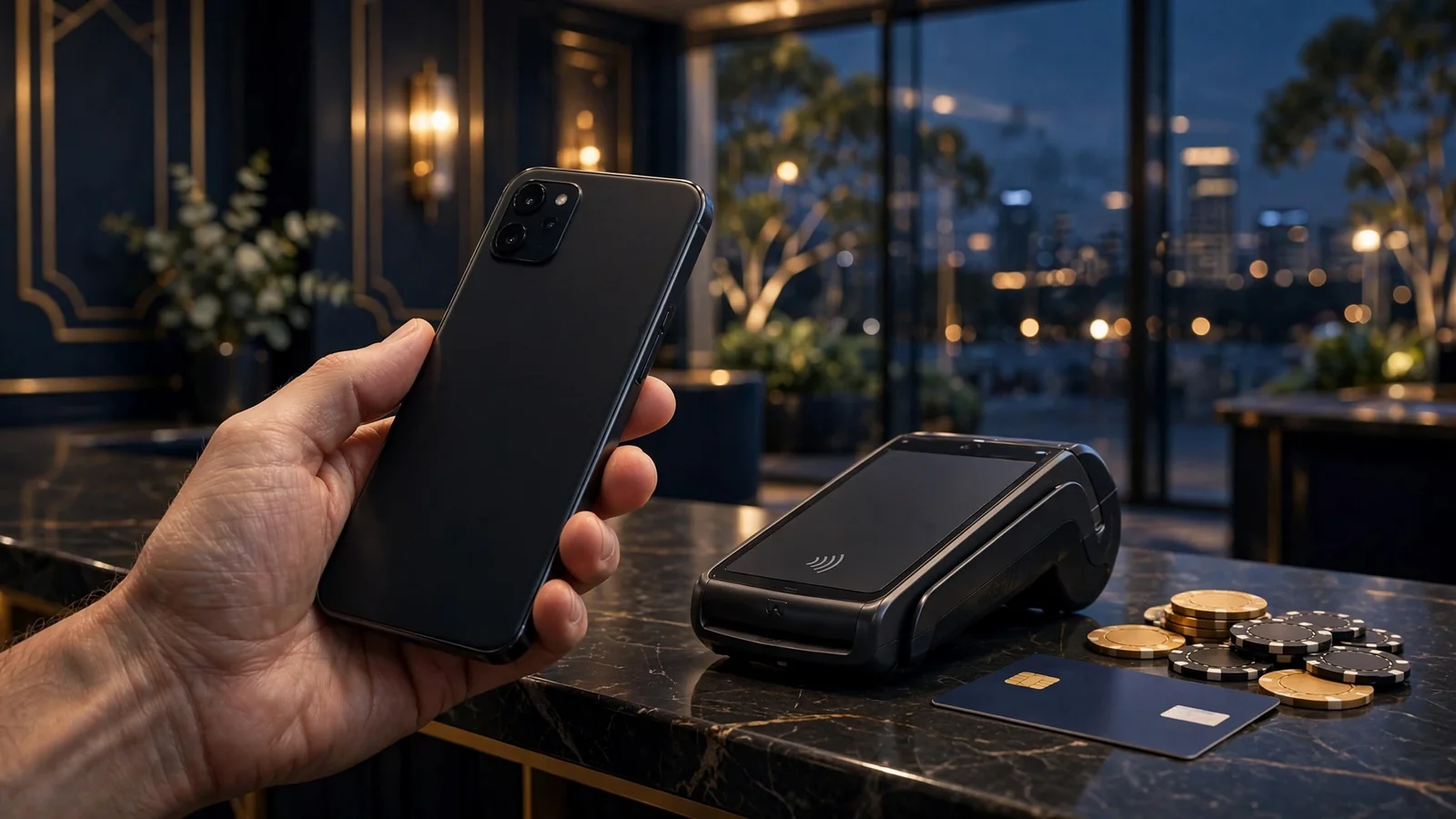
In Australia, paying by tap has become part of ordinary life. Contactless credit and debit cards are accepted almost everywhere, and mobile wallets such as Google Pay and Apple Pay are also widely accepted in everyday settings. That familiarity can make a phone feel like a straightforward substitute for a physical card. But acceptance in shops and other routine transactions does not establish that an online gambling service accepts the same wallet.
The distinction matters when you are trying to understand whether Google Pay can be used for an online casino transaction. A wallet’s broad use across Australia describes the general payment environment; it does not confirm the payment methods available at any particular service. The words “Google Pay” on a device, card or checkout elsewhere cannot, by themselves, tell you what an online cashier supports.
Australian consumers are comfortable moving between cards, mobile wallets and services linked to bank accounts, such as PayPal. That flexibility is useful in everyday spending, where the payment choice can depend on the shop, the device or the account a person prefers to use. It can also shape expectations: if a wallet works across many familiar settings, you may naturally wonder whether it works in other online contexts too.
Google Pay availability can depend on the casino and your payment setup, so check the cashier before you deposit. Use this list to review the operator details available for each option.
SpinsUp
You can note its stated Curaçao Gaming Control Board licence: OGL/2023/174/0082, held by Dama N.V. No Google Pay or other payment details are provided here.
WinSpirit Casino
You can note its stated Antillephone N.V. licence, Curaçao eGaming OGL/2024/923/0383, and minimum deposit of A$30. Google Pay availability is not specified here.
LuckyVibe
Its stated licence is Curaçao Gaming Control Board OGL/2023/176/0095, held by Hollycorn N.V. No payment details are provided here, so check whether Google Pay is available.
GoldenCrown
Its stated licence is Curaçao Gaming Control Board OGL/2023/176/0095, held by Hollycorn N.V. Google Pay availability is not specified here.
MrPacho
You can review its stated minimum deposit of A$30 and payout estimates: crypto withdrawals take 30–120 minutes, while fiat withdrawals take 24–72 hours. Google Pay availability is not provided.
Ricky Casino
You can note the A$20 minimum deposit, or A$30 to qualify for the bonus. Stated payout estimates are under one hour for crypto and 1–3 business days for PayID; Google Pay availability is not specified.
Golden Pokies
The available detail is a Curaçao licence. You’ll need to check the casino’s cashier to find out whether it accepts Google Pay.
Wild Tokyo
You can note the A$10 minimum deposit and stated payout estimates: crypto takes 30–60 minutes, while fiat takes 1–5 days. Its listed licence is Curaçao; Google Pay availability is not specified.
Bizzo Casino
Its stated licence is from the Curaçao Gaming Control Board, with TechSolutions Group N.V. named. No Google Pay or other payment details are provided here.
DragonSlots Casino
Its stated licence is from the Curaçao Gaming Authority, with Jumpman Gaming Ltd named. Check the cashier for Google Pay availability, which is not specified here.
That expectation is not the same as confirmation. Payment acceptance is specific to the business and transaction in question. A merchant may accept contactless card payments while not accepting a particular wallet; an online checkout may offer different choices from a physical terminal. The fact that a payment service is familiar to Australian consumers does not show that it is available for every type of purchase.
This is why phrases such as “Australian online casino with Google Pay” need careful interpretation. They express a desired payment option, not proof that the option is actually supported. The same applies to references to online pokies or a mobile casino: a wallet’s presence in everyday Australian commerce cannot verify what a gambling service offers. General popularity and service-specific acceptance are separate matters.
The phone itself can also make the distinction less obvious. A wallet may hold or access a card, while a merchant’s checkout may process only certain card types or payment routes. From the user’s perspective, both may involve tapping a phone or choosing a saved payment option. From the merchant’s perspective, they can be different transactions with different acceptance rules. Seeing a familiar wallet interface does not mean every online checkout connects to it.
A useful way to think about Google Pay is as one part of Australia’s wider mix of payment habits, not as a universal payment credential. Many people switch among cards, mobile wallets and bank-linked services depending on what a particular business accepts. That flexibility is ordinary; it does not mean all those methods are interchangeable at every point of sale or online service.
For anyone considering the phrase “casinos that accept Google Pay Australia,” the key distinction is between national payment habits and a specific service’s payment arrangements. Australia’s broad use of contactless cards and mobile wallets provides context for why the option may sound familiar. It does not establish casino availability, nor does it show that a wallet can be used for a particular transaction.
Keeping those ideas separate prevents a common assumption: that a payment option widely used in Australian retail must also be offered in online gambling. Familiarity tells you that many Australians use mobile wallets. It does not tell you whether an online cashier includes Google Pay, whether a transaction would be processed through it, or whether the service is suitable or lawful for you to use. Those are distinct questions, and they should not be answered by general retail acceptance alone.
A mobile wallet being familiar on your phone does not mean it is available as a deposit route at a particular gambling website. The payment option depends on what the operator offers and what its payment arrangements allow. Treat the wallet’s presence in everyday life as separate from whether it appears as an available method for a particular service.
Before taking any financial step, look for the payment information provided for that specific account and location. Check whether Google Pay is named for deposits, rather than relying on a general statement that the site supports mobile payments. “Mobile wallet” can describe several different services; it does not, by itself, identify which one is accepted. A logo or a mention in a broad list is not enough to tell you that the route is available to you.
Pay attention to the wording around the payment method. A page might refer to Google Pay as a feature, describe a wallet as an option for some customers, or list it alongside other payment services without clarifying its use for deposits. Those statements are not interchangeable. What matters for the question of a deposit is whether the operator’s current payment information specifically identifies Google Pay as a way to add funds, and whether that information applies to Australian users.
The amount in a search or a page title is not proof of a minimum deposit. A phrase such as “$10 deposit” may express what someone hopes to deposit, not a confirmed condition of the payment route. Do not assume that a particular amount will be accepted because it appears in a headline or discussion. If payment terms state a minimum or maximum, read the current terms directly and check that they refer to the relevant method and account. If no clear limit is stated, do not fill in the gap with an estimate.
A useful check is to distinguish the wallet itself from the underlying card or funding source. A payment can involve more than one party: the service processing the transaction, the wallet, and the institution connected to the wallet may each affect whether it proceeds. Availability of a wallet feature on your device does not settle whether a transaction to a particular website will be accepted. Nor does a general claim about card acceptance establish that the same card can be used through Google Pay.
The same care applies to labels such as “instant,” “easy” or “one tap.” These describe a broad experience, not a confirmed payment route for your account. Before entering personal or payment details, look for clear information about the method, the applicable terms and any conditions that could affect a deposit. If the information is unclear or inconsistent, pause rather than relying on a promotional description or an assumption based on another service.
Payment availability can also differ by method. A specialist review has reported that some online casinos do not take American Express, but that observation does not establish a general rule and says nothing about Google Pay. It is a reminder that one payment option cannot be used as evidence for another. Even where a site names a wallet, you should not infer that every card or account linked to it will work.
Account checks are another separate part of the process. Online gambling services commonly ask customers to complete identity checks before handling financial transactions. That requirement is distinct from whether Google Pay appears as a deposit method: having an account, completing identity checks, and seeing a wallet listed do not prove that a specific payment will be accepted. Read the relevant account and payment information before sharing documents or payment details, and avoid treating a successful check in one area as confirmation of another.
Keep the question narrow: does the operator’s current information explicitly identify Google Pay for deposits for your circumstances? General mobile-wallet acceptance, an available app on your phone, another person’s experience, or a listed card brand cannot answer that on its own. A clear, method-specific statement is more useful than a broad promise. If the route is not plainly described, you do not have a sound basis to assume it is available or to proceed as though it were.
A statement that a casino accepts Google Pay is not, by itself, enough to establish that the wallet is available to you. Treat claims of acceptance as unconfirmed unless the operator’s own current payment information clearly names Google Pay and applies to Australian customers.
Wording matters. A page may mention Google Pay while discussing mobile payments generally, or describe a wallet as an option without confirming that it can be used for the service you are considering. A logo or a broad “digital payments accepted” label is also less specific than a clear statement naming Google Pay. These details can help you judge what a claim actually says, but they do not turn an unclear claim into confirmation.
Look for the precise relationship being asserted. Does the information say Google Pay is accepted, or does it only mention mobile wallets? Does it refer to Australian customers, or speak generally about the operator’s services? Is the statement current, and is it made by the operator rather than repeated by another page?
A claim may be narrower than its headline suggests. “Google Pay available” does not necessarily establish that the wallet works for every account, in every location, or for every transaction type. Nor does a mention of Google Pay establish that it is available for both deposits and withdrawals. Those are separate capabilities and should not be inferred from one another.
That distinction is important when you see lists described as the best casinos for Google Pay deposits or as sites offering instant Google Pay withdrawals. A ranking label does not prove that any listed provider supports the method. The word “instant” adds another assertion, not evidence of acceptance. Without clear, current confirmation of the exact capability, the claim should not be treated as a dependable basis for a decision.
Promotional language can make a payment claim sound more certain than the supporting detail warrants. “Top choice,” “best site,” or “recommended” describes an opinion or ranking; it does not confirm that Google Pay is currently supported. A list may also combine different payment methods under a broad wallet category, leaving unclear whether Google Pay itself is included.
The same care applies to mentions of games or pokies alongside Google Pay. A wallet label does not demonstrate that a particular game is available, and a game-related phrase does not confirm payment support. Keep these claims separate rather than letting one serve as proof of the other.
Australian payment options can change, so an old third-party page may not reflect what an operator currently states. A specialist review, for instance, has reported that deposits using Amex are available at some Australian online casinos. That sort of report is specific to its subject and should not be stretched into evidence about Google Pay. It illustrates why claims need to be assessed method by method, rather than assuming that support for one payment option proves support for another.
If a page does not clearly name Google Pay and specify the scope of acceptance, the safest reading is that it has not established the claim. You do not need to treat every vague reference as false; you do need to avoid treating it as confirmed. A provider list that lacks clear, current details cannot reliably tell you which casino sites take Google Pay.
This is particularly relevant when a page uses confident language but offers no precise statement about the wallet. A careful reading keeps the claim in proportion: a mention is a mention, a recommendation is a recommendation, and neither alone confirms actual acceptance.
A payment can arrive quickly at the deposit stage without being returned at the same speed. These are separate parts of a transaction: money going into an account and money being sent back after a withdrawal request. Treating them as one process can leave you with an inaccurate expectation about when funds will reach you.
That distinction matters when you see a claim about an instant Google Pay deposit. Even if a payment method is accepted and a deposit is processed promptly, that tells you only about the incoming transaction. It does not establish that withdrawals use the same route, that the wallet can receive a payout, or that a withdrawal will be completed immediately. There is no basis for treating an “instant” label on one stage as a promise about the other.
Amex provides a limited comparison. Casino deposits made with Amex are described as processing instantly, but that timing concerns deposits alone. A specialist review has reported that Amex casino withdrawals can take up to five days to clear. That reported timeframe is specific to the Amex example; it is not a general rule for every casino or payment method, and it says nothing about Google Pay withdrawal speed.
The difference is not merely a matter of how quickly a payment button responds. A withdrawal has its own handling and clearance stages. A casino may need to process a request before funds are sent, and the receiving route may then have its own timing. A fast deposit does not tell you how those stages work or how long they take. Nor does a status such as “processed” necessarily mean the funds have arrived in your account.
This is why descriptions such as “instant withdrawal” need careful reading. The phrase may refer to the operator’s handling of a request, rather than the time until money is available to you. Unless the terms clearly define what is instant, the wording alone cannot settle the question. It should not be read as a guarantee that a Google Pay payout will be immediate.
Be particularly cautious about carrying a deposit claim across to a withdrawal claim. A wallet could be presented as a way to pay in, while the payment route for money out is different or not specified. The two directions are distinct, and a deposit speed cannot confirm withdrawal eligibility or clearance time. Those details need to be stated separately; if they are not, the advertised speed leaves an important part of the transaction unanswered.
Searches for instant Google Pay withdrawals can make these ideas seem interchangeable, but they are not. “Instant” may describe only one part of a payment, and the Amex comparison shows why deposit timing cannot be used as evidence of payout timing. No Google Pay withdrawal speed should be inferred from it. Keep the incoming and outgoing stages separate when interpreting any payment claim, and do not rely on an instant-deposit description to predict when a withdrawal would reach you.
A payment label does not change the legal position of an online casino. Whether a site says it accepts Google Pay, a debit card or another method, that claim does not make its casino service lawful for people in Australia.
Under the Interactive Gambling Act 2001, operators must not provide real-money online casino games to people physically located in Australia. The restriction applies to the operator’s conduct; it is not written as an explicit criminal offence for an individual player who uses an offshore site. That distinction matters, but it should not be read as an endorsement or assurance that using such a site is risk-free.
The Australian Communications and Media Authority (ACMA) oversees enforcement of the Act. Offshore services may be subject to enforcement measures and access blocking in Australia. A site being reachable at a particular moment does not show that it is permitted to serve Australian residents, nor does a successful payment establish that the service is lawful.
There is also a practical difference between a site’s terms and the protections available to you. Australian consumer law does not protect players using offshore casinos. If an overseas operator disputes a balance, restricts an account or fails to deal with a complaint, you may not have the protections or accessible remedies you would expect from a business operating under Australian consumer rules. A payment provider’s involvement does not supply those protections either.
That is why a claim about Google Pay acceptance should not be treated as evidence that an offshore casino is approved for Australian use. Payment processing and legal permission are separate matters. A wallet may be presented as a way to fund an account, but that does not change the operator’s obligations under Australian law or create local consumer safeguards for you.
Be cautious about statements that blur these issues. A site may describe itself as available to Australians or refer to an overseas licence, yet neither wording changes the prohibition on operators providing real-money online casino services to people in Australia. Nor does it make Australian consumer law apply to an offshore business. Availability, payment acceptance and legal status are not interchangeable.
If you are weighing a payment claim, keep the legal question separate from the technical one. A displayed Google Pay option can only speak to a proposed payment route; it cannot establish that the casino may legally offer its service to you, that ACMA will not take enforcement action, or that you will have Australian consumer protections if something goes wrong. The absence of an explicit player offence does not remove those practical risks.
The key point is not whether an offshore cashier displays a familiar wallet. It is that Australian law places the prohibition on the operator, while players using offshore casinos remain outside Australian consumer-law protection. A payment method cannot bridge that gap.
A payment option and a game catalogue answer different questions. Google Pay, where supported for a transaction, describes a way to pay; it does not identify what an online service offers or establish that any particular game is available to you. A label such as “Google Pay casino games” can therefore blur two separate claims.
The same distinction applies to a mobile casino. A site may describe its payment facilities separately from its content, but neither description confirms the other. A Google Pay symbol does not show that a catalogue is complete, current or accessible from Australia. Nor does a list of games, if one appears, prove that Google Pay can be used to fund activity connected with them.
That matters because the phrase “casino games with Google Pay” can sound as though the wallet is tied to particular titles. It is not. A payment method is not a game filter, a catalogue feature or evidence of a relationship between a wallet provider and a game. Searches for Google Pay casino games, including slot-related wording, should not be treated as confirmation that any named game can be accessed or paid for through the wallet.
There is a separate Australian issue: the Interactive Gambling Act 2001 prohibits operators from providing real-money online casino games to people in Australia. A payment method cannot alter that restriction. An offshore site’s payment label or game description does not make its service lawful to provide here, and Australian consumer law does not protect players who use offshore casinos.
Keep the two questions distinct when reading claims: what a payment label purports to cover, and what content a service claims to make available. Neither answer should be inferred from the other. In particular, a reference to a wallet does not verify a game, while a game listing does not establish that the wallet is accepted for a transaction. Treating those as separate claims helps prevent a broad payment label from being mistaken for confirmation of a specific offering or access in Australia.
A reference to Google Pay alongside pokies does not make material about real-money play suitable for Australian audiences. The payment label may appear in a headline, a bonus description or a promotional message, but changing the wording does not remove the advertising restriction.
In Australia, advertising real-money interactive gambling services, including online casinos, is prohibited. Pokies are also among the online casino-style games treated as prohibited interactive gambling services when offered to people in Australia. This means that advertising a casino bonus tied to a wallet, or presenting a list of casinos as a way to find such offers, can still promote restricted gambling services. Mentioning Google Pay does not create an exception.
That distinction matters because a promotion can be framed around a payment method rather than a game. A bonus advertised as a wallet offer may still encourage people to use an online casino. Adding terms such as “deposit offer” or “payment reward” does not change the substance if the message is promoting real-money casino play. Nor does a general disclaimer make prohibited advertising acceptable.
For you, the practical point is not to treat promotional wording as proof that an offer is lawful or available. A search result, social post or message using a wallet name may be promotional material, not a neutral explanation of a payment feature. Avoid relying on bonus claims as a reason to share personal or payment details.
The rules also do not depend on whether the material names a particular game. An advertisement can promote online casino services without listing individual titles, and a reference to pokies can itself put the material into a restricted area. This is why responsible information should explain the boundary without naming or promoting games, operators, or offers.
If you encounter material aimed at Australians that appears to advertise real-money online casino play, the presence of a familiar payment brand should not be taken as reassurance. The advertising restriction concerns the gambling service being promoted, not whether the promotion mentions a wallet, a bonus or a particular payment route.
A payment option shown for adding funds does not, by itself, show that the same route can receive a withdrawal. Deposit and payout rules can be separate, so a label in a cashier should not be treated as confirmation that winnings can be returned through that method.
That distinction matters when you are trying to establish whether Google Pay can be used for a casino withdrawal. The presence of Google Pay as a deposit option would not prove it is available for payouts; nor would a general claim that a casino accepts the wallet settle the withdrawal question. You would need a clear statement about withdrawals, not merely a payment logo or a deposit description.
Amex illustrates why the two directions need to be checked independently. A specialist review reports that some casinos do not allow winnings to be withdrawn to Amex, while others may attach an extra withdrawal fee. The same review notes that an Amex withdrawal may depend on having first made a deposit with Amex. These are reported conditions, not a rule that applies to every casino, and policies can differ between operators.
A separate specialist review also reports that Amex withdrawals are not available at every Australian-facing online casino. That does not establish anything about Google Pay, but it shows why you should not assume that a method accepted for deposits is automatically a payout route. Even where a method appears in both parts of a cashier, eligibility may still depend on the operator’s own terms and the details of your account.
Before relying on any payment label, look for explicit wording about withdrawal eligibility and any associated fee. If the terms are unclear, ask the operator to confirm whether that exact method can receive a payout. Do not treat a successful deposit as proof: it confirms only that the deposit was accepted, not that a later withdrawal can use the same route. This is particularly important when the payment method is a digital wallet, since its use for one transaction does not establish how the operator handles outgoing funds.
Australian consumers are comfortable moving between cards, mobile wallets and services linked to bank accounts, such as PayPal. That flexibility can make a wallet seem like a natural option when you are considering an online payment. But a familiar way to pay in everyday life does not show that a particular gambling site accepts the same method.
The distinction matters when you are looking for an Australian casino with Google Pay. The country in the search term describes the audience, not necessarily the payment arrangements of a service. A wallet may be familiar to Australian users while its availability for a specific online transaction remains a separate question. Nor does seeing a wallet mentioned in general payment information establish that it is available in a particular cashier.
Card acceptance can also vary by payment brand. A specialist review has suggested that Visa may be accepted more broadly at Australian online casinos than Amex. That is a limited, changeable observation, not a reliable rule for every operator or a substitute for checking the payment information attached to the service you are considering. It also says nothing about Google Pay, which should not be assumed to follow the same pattern as either card.
Your own routine may therefore be a poor guide to what an online service supports. Being used to tapping a phone, paying by card or using a bank-linked service does not mean that each route will be offered for every transaction. Treat the cashier’s stated options as specific to that service, rather than extending general Australian payment habits to it.
This is a useful distinction to keep in mind: local familiarity can explain why Google Pay feels like an obvious option, but it cannot establish casino acceptance. A payment method has to be supported in the relevant setting; the fact that Australians commonly switch between ways to pay does not confirm that support.
A payment label tells you what a page claims, not necessarily what you can use. Seeing Google Pay mentioned beside a casino name does not, by itself, confirm that the wallet is available to Australian customers, works for deposits, or can be used at the point you intend to pay. The label may describe a general payment feature, a service for another region, or an option that has since changed.
That distinction matters because mobile wallets are accepted almost everywhere in Australian retail, but everyday acceptance does not carry over automatically to gambling websites. A casino and its payment providers make separate decisions about which methods they support. The phrase “Google Pay casino” therefore cannot establish that a particular operator accepts Google Pay.
Nor does a wallet label confirm a payout route. Deposit and withdrawal options can differ, and a payment method appearing on a page does not prove that winnings can be returned through it. Treat claims about a “Google Pay payout” as a separate claim requiring clear, current terms—not as a consequence of seeing the wallet named.
Other payment labels should not be treated as interchangeable either. A specialist review has reported that some online casinos do not accept Amex, illustrating that one payment method’s availability says nothing definite about another’s. Google Pay, Apple Pay, cards and bank-linked services each need to be considered on their own terms.
Before making a financial decision, look for an explicit statement from the operator that identifies Google Pay and the relevant transaction type, and check whether the information applies to Australian users. If the wording is vague, the label is not confirmation. Also remember that Australian consumer law does not protect players who use offshore casinos. A familiar wallet name cannot change that legal and consumer-risk position.
Check the casino’s cashier or payment information for American Express as a deposit option for Australian players. Jackpot City Casino, Spin Palace, Ruby Fortune, Ignition Casino, Joe Fortune and PlayAmo are listed among operators that accept Amex deposits.
Each casino sets its own Amex deposit and withdrawal limits, so they can vary between operators. Check the current limits in the casino’s cashier or payment terms; Amex limits are usually higher than those for Mastercard and Visa.
Amex deposits typically have no fee, but a casino may charge a 1.5% surcharge, and Amex cards incur a 3% currency conversion fee. Withdrawal fees may also apply.
Yes. Each casino sets its own Amex deposit and withdrawal limits, which can vary, so check the limits shown in that casino’s cashier or payment terms.
Check whether Amex or your Australian bank is blocking gambling transactions to that website. Amex may block payments to particular sites, and banks can also block gambling-related Amex transactions.
Amex deposits typically have no fee, but a casino may add a 1.5% surcharge and Amex cards incur a 3% currency conversion fee. Withdrawal fees may apply depending on the casino.