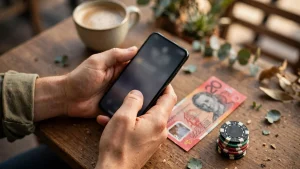
Bitcoin is a payment method, while game credits are a separate measure of play; the distinction matters for deposits, withdrawals and real-money access.

Bitcoin pokies are digital slot-machine games that accept Bitcoin as a payment method. The Bitcoin element relates to how money may be used with the game; it does not change the basic distinction between playing without money and playing for real money. Those are different ways to access online pokies, and it is important to know which one is in use before treating game credits as cash.
In free play, you can use the game without staking real money. Any credits shown in that mode are part of the game experience: they let you make plays within the software, but they are not Bitcoin in your wallet. A balance displayed on screen should not be read as money you can withdraw merely because the game is associated with Bitcoin.
Real-money play is different because Bitcoin is used as payment. Even then, a displayed game balance is not necessarily a direct Bitcoin balance. The game may represent play through credits, while Bitcoin is the payment currency. These are separate units: one describes what the game lets you stake, and the other describes the currency used to pay.
If you’re exploring bitcoin pokies in Australia in 2026, this list gives you a concise reference point for checking the details available about each operator. Review the stated licensing or payment information and confirm that an option suits your needs before you play.
SpinsUp
You can note the listed Curacao Gaming Control Board licence, OGL/2023/174/0082, held by Dama N.V.
WinSpirit Casino
You can note its Curacao eGaming licence, OGL/2024/923/0383, held by Antillephone N.V., and a minimum deposit of A$30.
LuckyVibe
You can note the listed Curacao Gaming Control Board licence, OGL/2023/176/0095, held by Hollycorn N.V.
GoldenCrown
You can note the listed Curacao Gaming Control Board licence, OGL/2023/176/0095, held by Hollycorn N.V.
MrPacho
You can take its stated payout timings into account: crypto payouts take 30–120 minutes and fiat payouts 24–72 hours. The minimum deposit is A$30.
Ricky Casino
You can take its stated payout timings into account: crypto payouts take under 1 hour and PayID payouts 1–3 business days. The minimum deposit is A$20, or A$30 to qualify for the bonus.
Golden Pokies
You can note that Curacao is listed as its licence jurisdiction.
Wild Tokyo
You can take its stated payout timings into account: crypto payouts take 30–60 minutes and fiat payouts 1–5 days. Its listed licence is Curacao, and its minimum deposit is A$10.
Bizzo Casino
You can note the listed Curacao Gaming Control Board licence, associated with TechSolutions Group N.V.
DragonSlots Casino
You can note the listed Curacao Gaming Authority licence, associated with Jumpman Gaming Ltd.
A specialist review has described game credits as specific to each individual game, with their Bitcoin value depending on the game and the current BTC price. This is a source-specific description, not a fixed rule that can safely be applied to every game or platform. It also means that a number of credits cannot be translated into one universal Bitcoin amount. The relationship needs to be understood in the context of the particular game and the price at the relevant time.
That distinction matters when you compare what appears on screen with what you paid. A credit total is a game unit, not a standard denomination shared across all pokies. Different games can define credits differently, so the same credit count does not establish that two games represent the same Bitcoin value. And because the stated Bitcoin value depends partly on the current BTC price, a conversion observed at one time may not describe it at another.
Before treating any displayed amount as meaningful, separate three things in your mind: the payment currency, the game’s credit unit, and the mode you are playing. Free-play credits belong to the game and do not become real money simply by being displayed. In real-money play, credits still belong to the game’s own system; Bitcoin is the payment currency. Keeping those concepts apart makes it easier to understand what a balance does—and does not—tell you.
The word “Bitcoin” can make a game sound as if it operates directly in Bitcoin from start to finish. That is not what the description of game credits establishes. It tells you that Bitcoin may be accepted as payment and that a game may display its own credits. It does not, on its own, tell you how a particular game sets its credit value or how a displayed balance should be interpreted. Those details can vary, so avoid assuming that a game’s credit counter is equivalent to a wallet balance.
Free play can help you see how a game presents its credits, but it does not establish the value of real-money play. A free-play balance is not evidence that the same amount of credits would cost a particular quantity of Bitcoin. Likewise, seeing a Bitcoin payment option does not mean the game’s internal units are denominated in Bitcoin. The mode and the unit both matter.
This distinction is useful whenever you read a description of Bitcoin pokies. Ask whether it refers to the game itself, its payment option, or the credits shown during play. Those terms can be blurred in casual descriptions, even though they refer to different things. Treat credit values as game-specific rather than assuming they form a common scale, and do not infer a Bitcoin equivalent unless the particular game’s terms make that relationship clear.
Real-money play is for adults aged 18 or older. This section is informational, not an invitation to play: the content is affiliate material and may include sponsored links.
The legal position in Australia is not determined by whether an online casino accepts Bitcoin or displays a gambling licence from another country. The key issue is whether an operator is providing real-money online casino services to people physically located in Australia. Under the Interactive Gambling Act 2001, operators are prohibited from providing those services to people in Australia. Online pokies, along with other casino-style games, fall within that prohibition.
This means there is no locally licensed online casino that can lawfully offer real-money pokies to Australian residents. An offshore licence does not change that position. Operators discussed in connection with Bitcoin pokies Australia hold licences primarily from Curacao eGaming or the Anjouan Gaming Authority, but those licences are issued outside Australia. They are not Australian authorisations and do not give an operator permission under Australian law to provide prohibited services to people here.
The distinction matters because a licence can describe an operator’s relationship with a foreign regulator, not the protections available to an Australian customer. It does not establish that Australian regulators supervise the operator, that Australian standards govern its conduct, or that an Australian consumer can rely on domestic remedies if a disagreement arises. In particular, Australian consumer protection laws do not apply to the offshore operators discussed. A foreign licence should not be mistaken for equivalent local oversight.
The prohibition is directed at the operators providing the service. Australian law does not impose a fine or criminal prosecution on an individual simply for playing at an offshore casino. That does not make the service locally authorised or remove the practical risks of dealing with an operator outside Australia. The operator’s legal position and the player’s position are separate questions: the fact that a player is not liable for using the service does not mean the service is lawful for the operator to provide.
Real-money gambling is for adults aged 18 or older. Meeting that age threshold does not alter the restriction on operators offering online casino games to people in Australia. It is a minimum age requirement, not permission to use a service that is prohibited from being provided to Australian customers.
The Interactive Gambling Act also treats online casino-style games—including pokies, poker, blackjack and roulette—as prohibited interactive gambling services when offered to customers in Australia. This is why the payment method does not settle the legal question. Using Bitcoin rather than a bank card does not turn a prohibited online casino service into a locally authorised one.
Australian authorities can take action against operators that provide prohibited interactive gambling services. The Australian Communications and Media Authority (ACMA) enforces the relevant rules and can seek the blocking of offshore gambling websites. Access may therefore be restricted, and a website that can be reached at one point may not remain accessible. A changing web address or a foreign licence does not indicate that an operator has become authorised in Australia.
This enforcement setting is also relevant to advertising. Advertising online casino services to Australian audiences is prohibited. A page discussing the subject should not be read as an invitation to register or as a recommendation of any offshore service. An affiliate disclosure does not change the legal status of an operator or make promotion lawful: this content is affiliate material and may include sponsored links. That disclosure describes a commercial relationship; it does not provide consumer protection or endorsement.
For you as a reader, the practical point is to keep three ideas distinct: the legal rules governing operators, the absence of player liability for simply playing, and the limited protections available when an offshore business is involved. Combining them can create a misleading impression that an overseas licence makes an operator safe, locally regulated or accountable under Australian consumer law. It does not.
If a dispute arises with an offshore operator, you cannot assume that Australian consumer protection laws will apply or provide the same route to a remedy as they might in a domestic transaction. The operator may be located overseas, subject to a foreign licensing arrangement and outside the direct reach of Australian consumer protections. Even where a foreign regulator has a role, that is not the same as Australian oversight, and it does not guarantee a particular outcome for a customer.
A careful reading of any claim about legality should therefore ask what jurisdiction the licence comes from and whether it authorises the service in Australia. In this market, a foreign licence is not a substitute for local authorisation. Since real-money online casinos cannot be locally licensed to offer pokies to Australian residents, there is no domestic online-casino licence that makes such play lawful for an operator simply by being displayed on its website.
The law can be stated without exaggeration: the operator’s provision of real-money online casino games to people in Australia is prohibited; an individual player is not fined or prosecuted merely for playing; and Australian consumer protection laws do not cover the offshore operators discussed. Those points do not guarantee access, fair treatment or a remedy. They describe the legal limits within which any account of offshore gambling in Australia should be understood.
A Bitcoin payment starts with an address, but the deposit and withdrawal steps run in opposite directions. For a deposit, you copy the payment address shown by the gambling service and send Bitcoin to it from your own wallet. For a withdrawal, you provide your wallet address in the service’s withdrawal form so it can send Bitcoin to you.
These steps may look simple, yet each depends on accurate details and on separate processes: your wallet submits the transfer, the Bitcoin network records it, and the service recognises or approves the payment. A transfer being sent does not necessarily mean that the service has credited a deposit or released a withdrawal.
If you choose to make a payment, first check that the address displayed for the deposit matches the one you intend to use. Copy it rather than typing it by hand, then compare the address in your wallet with the one provided. Be cautious if an address changes between visits or if you are asked to use an address from an old message: the payment page should show the destination for the transaction you are making.
Next, enter the amount in your wallet and review the details before sending. The wallet will submit the transaction to the Bitcoin network. Once sent, it cannot generally be cancelled like a bank payment. If you send Bitcoin to the wrong address, recovery is generally not possible because blockchain transactions are irreversible. The same caution applies to Ethereum transfers, even though the payment steps and address formats differ.
After sending, keep the transaction record available. The service may need to identify the incoming payment before it appears in your account. A delay in that recognition does not, by itself, establish that the funds have been lost; the payment may be pending or awaiting the service’s processing. Avoid sending another payment simply because the first one has not appeared. Check the transaction details and contact the service through its stated support channel if the account does not update.
Sending a Deposit
Copy the address
Copy the payment address shown by the service and compare it with the one in your wallet to ensure they match.
Review and send
Enter the amount in your wallet and review all details before submitting the transaction to the Bitcoin network.
Save the record
Keep the transaction record available so the service can identify the incoming payment.
An operator’s own payment description may present cryptocurrency deposits and withdrawals as almost instant, contrasting them with delays associated with conventional banking. Treat that as a description of the intended payment experience, not a guarantee that every stage will be immediate. A wallet’s submission, network processing and the operator’s account crediting are distinct events.
To request a withdrawal, copy your own Bitcoin wallet address and paste it into the service’s withdrawal form. Check every character and confirm that the address is for receiving Bitcoin. A valid-looking address is not enough if it belongs to the wrong wallet or is for a different type of asset. Once the service sends the transaction to an incorrect destination, the transfer is generally unrecoverable.
A request may also pass through the operator’s internal handling before any Bitcoin is sent. The form being submitted is therefore not the same as a completed transfer. After processing, the service should provide a transaction record or other confirmation that lets you identify the payment. Keep that information until the funds have arrived in your wallet.
A specialist review has reported that most Bitcoin withdrawal transactions are completed within an hour. That is a report from a particular kind of source, not a timetable you can rely on for every operator or request. A withdrawal can take longer if it is waiting for internal processing or another check. Do not assume that a delay means you should make another deposit: adding funds to unlock a stuck withdrawal is not a safe response.
Bitcoin transfers involve miner’s fees, which vary over time. A specialist review has described these fees as generally very small, but the amount can change, so do not treat that description as a fixed cost. Check the fee shown in your wallet before confirming a payment and look at any fee information the service provides for withdrawals. The amount received can be affected by charges or deductions, so compare the requested withdrawal with the amount that reaches your wallet.
A payment may move quickly through one part of the process and still wait at another. The network transfer and the operator’s review are not interchangeable: a transaction record can show that Bitcoin was sent without confirming that the service has credited a deposit, while a submitted withdrawal form does not prove the Bitcoin has left the operator’s wallet. Keep the deposit or withdrawal reference, the relevant address and any transaction record together. Never share wallet recovery words or private keys to prove that you made a payment; a transaction record is not a reason to hand over control of your wallet.
Real-money gambling is restricted to people aged 18 or older. Australian consumer protection laws do not apply to the offshore operators discussed, so do not treat a payment page or a promised processing time as a consumer guarantee. This article is affiliate material and may include sponsored links; that disclosure does not make a payment or operator recommendation.
If a transfer is delayed, separate what you know from what you do not: whether your wallet sent it, whether the address was correct, and whether the operator has acknowledged it. That distinction helps you describe the problem accurately without repeating a payment unnecessarily.
Claims about Bitcoin security, privacy and fees describe aspects of the payment network. They do not establish that a gambling operator is trustworthy, that a payment will be handled fairly, or that gambling is safer. Keep those questions separate: a payment method can have particular technical features while the service accepting it remains subject to its own risks.
Blockchain technology is often cited as the reason Bitcoin transactions are highly secure. The public ledger provides a record of transactions, and its design makes that record difficult to alter. This can help protect the integrity of the network’s transaction history. It does not protect every part of a payment arrangement. A secure network cannot correct a mistake made when someone controls a wallet, nor can it ensure that a business will process a payment or honour a withdrawal as expected.
The distinction matters because security is not a single property. The Bitcoin network, the wallet software used to access funds, the device on which that software runs and the recipient of a payment are separate parts of the picture. A weakness or mistake in one does not become harmless just because another part uses blockchain technology. Transactions sent to an incorrect address are generally unrecoverable: once recorded, they cannot simply be reversed through a bank or customer-service request. That makes careful handling of addresses important, but it is not a guarantee against other kinds of loss.
You may also see Bitcoin described as offering more anonymity than conventional payment methods. A specialist review may present it as a more private way to pay, but “more private” does not mean anonymous. A Bitcoin transaction is associated with wallet addresses and recorded on a public ledger. The address does not automatically display a person’s name, yet that alone does not prevent activity from being linked to an individual. Information held by a wallet provider or another service, or details shared by the user, can connect an address with an identity.
This means you should not treat Bitcoin as a way to make activity untraceable. Nor should you assume that using a cryptocurrency removes the need for identity checks. A service may still ask for information about an account or seek to establish who controls a wallet. Privacy also depends on how the wallet and related services are used, not merely on the fact that a payment is made in Bitcoin. The practical level of privacy can therefore differ between people and circumstances.
Fee claims need similar care. Specialist reviews sometimes describe Bitcoin transaction fees as lower than charges for credit cards or other conventional payment methods. That comparison is not a fixed rule for every transaction. Bitcoin fees vary over time, and the total cost relevant to you may include more than the network fee. The service you use to obtain or hold Bitcoin, and the receiving service’s own terms, may affect what you pay. A claim about comparatively low fees should not be read as a promise that a particular payment will be free or cheaper.
The word “instant” can also blur different stages. A network transfer, a payment being recognised by a recipient and a business deciding what to do with funds are not necessarily the same event. Bitcoin’s technical design does not, by itself, guarantee that every service will act immediately. The speed or cost of a transaction should therefore not be confused with the reliability of the organisation on the other side.
When you come across claims about Bitcoin pokies or online payments, look at what the claim actually covers. “Secure” may refer to the transaction network, rather than account security or the conduct of a business. “Private” may mean that a wallet address is not automatically a person’s name, rather than that activity cannot be traced. “Low fees” may describe a comparison made in a particular review, rather than the total cost you would face. These distinctions keep payment features from being mistaken for guarantees.
The same caution applies to any suggestion that a payment feature makes a gambling service a better choice. Bitcoin’s characteristics do not assess an operator’s conduct, settle a dispute or ensure that funds can be recovered. A payment technology is not an endorsement. Treat descriptions of its advantages as claims about the payment method itself, not as evidence that using it for gambling is safe or suitable for you.
This page is affiliate material and may include sponsored links. That disclosure does not change what the payment features can establish: they cannot guarantee an outcome or remove the risks attached to sending funds. In Australia, real-money online casino games are prohibited services when offered to people physically located in the country, and Australian consumer protection laws do not apply to offshore operators discussed in this context. You must be at least 18 to participate in real-money gambling. Payment claims do not alter those limits or provide a safeguard if something goes wrong.
Claims that a site is “the best” can sound definitive while hiding what is actually being compared. A favourable review may focus on game choice or a bonus, while giving little attention to conditions that determine whether bonus winnings can be kept. Treat praise as a claim to examine, not as proof that an operator is suitable or that its terms are fair.
This page is affiliate material and may include sponsored links. That commercial relationship does not establish the accuracy of a claim or make an offshore service safe. No operator is named or endorsed here. The operators discussed in this context are offshore, and Australian consumer protection laws do not apply to them. An overseas licence is not Australian authorisation to offer real-money pokies to people in Australia.
If you are considering any claim, read the underlying terms rather than relying on a short review or headline. Check whether the review explains how its conclusions were reached, whether it discloses a commercial relationship, and whether its details match the operator’s current terms. A specialist review may recommend comparing reputation, licensing claims and game variety; those are points to investigate, not a guarantee of quality. A collection of positive reviews cannot replace the actual rules that govern your account or a bonus.
A bonus can carry rules that affect both how it may be used and whether associated winnings remain valid. One detail worth checking is the wagering contribution assigned to each game. The percentage can differ substantially by category: table games may contribute nothing, while pokies may count fully. Some high-return pokies may have their contribution capped at half. If a review describes a bonus as generous but does not explain these differences, it leaves out information that can change how practical the offer is.
Look for the contribution table in the terms and confirm that it applies to the specific games you intend to play. Do not assume that every game contributes equally, or that a game’s appearance in a site’s catalogue means it counts towards bonus conditions. If the wording is unclear, treat that uncertainty as a real limitation rather than filling in the gaps with an optimistic interpretation.
Maximum bet rules deserve the same attention. Bonus terms may set a ceiling on the stake allowed while bonus conditions are active. If play goes beyond that limit, bonus play may be voided. A review that mentions a bonus but skips this restriction does not give you enough to assess the risk. Check when the limit applies, how the operator defines a bet, and what the terms say happens after a breach. If the wording is difficult to interpret, do not rely on assumptions about how it will be enforced.
Also distinguish the bonus balance from withdrawable funds. Promotional language may present a bonus as immediately useful, but its conditions can restrict eligible games or require particular play before winnings can be withdrawn. Avoid treating the headline amount as money you can freely access. The relevant detail is the full set of terms, including exclusions and consequences for non-compliance.
A broad claim about a large game selection tells you little about bonus eligibility, and a positive rating does not explain how a complaint was handled. Keep each claim in its own category: game range, bonus rules, licence information and customer-service statements are not interchangeable evidence. Be cautious when a review uses confident labels without showing the conditions behind them.
The phrase “proper licensing” can also mislead if it is left undefined. Offshore operators may refer to a foreign regulator, but that is not the same as being licensed in Australia, and it does not bring Australian consumer protections into force. Do not read a foreign licence claim as a promise that an Australian regulator will resolve a dispute.
Real-money play is for adults aged 18 or older. More broadly, Australian law bars operators from providing real-money online casino games to people located in Australia. This is not a reason to treat an overseas site as an authorised alternative; it is important context when judging claims aimed at Australian readers.
If bonus terms appear inconsistent across a review, promotional page and full rules, do not assume the most favourable version will apply. Preserve the wording you relied on and seek clarification before accepting an offer, but remember that a response from an operator is not a guarantee about a future dispute. The clearest assessment is one grounded in the applicable terms, not in a ranking or a promise.
A Bitcoin payment can be visible on the blockchain without appearing in an account straight away. A withdrawal request can also remain pending after it has been submitted. These are different problems: a deposit may not have been matched to your account, while a withdrawal may still be waiting for the operator to review or process it.
For deposits that are not credited, first compare the transaction details in your wallet with the instructions you were given. Check that you used the correct address and that the amount sent was not below the operator’s stated minimum, if one was specified. Reusing an address can also contribute to a deposit not being recognised, and the operator may not have detected the transaction yet. Keep the transaction record and contact the operator through its stated support channel with the transaction identifier and relevant details. Do not send another payment simply because the first one has not appeared.
Common causes include using an incorrect address, sending an amount below the operator's minimum, or reusing an old address. Additionally, the operator may simply not have detected the transaction on the blockchain yet.
Address errors are particularly serious. Bitcoin and Ethereum transactions sent to an incorrect address are irreversible and generally cannot be recovered. Before sending, check the full destination address rather than relying on a partial match, and make sure the wallet and destination support the same cryptocurrency. If a payment has already gone to the wrong address, a support request may help establish what happened, but it cannot reverse the blockchain transaction.
A pending withdrawal does not necessarily mean the blockchain transfer has started. The operator may still need to approve it, process a verification request, or include it in a batch handled during business hours. Approval queues, incomplete identity checks and business-hours processing are common causes of delay.
Review the withdrawal status and any messages in your account. If the operator asks for information, provide only what is required through its official account or support channel, and keep copies of the request and your response. If there is no clear explanation, ask whether the request is awaiting approval, verification or payment processing. That distinction can help you understand whether there is an action you can take or whether the delay is on the operator’s side.
A security review may also be raised after a significant win, particularly for a new account or a first large withdrawal. Such a review can be legitimate, but it can also be used as a stalling tactic. Ask what specific issue is being reviewed and what documents are needed. Keep a record of dates, messages and the withdrawal status. Be cautious if explanations keep changing or the operator asks you to deposit more money to release a stuck withdrawal. Do not pay an additional amount to unlock it.
Some operators request further identity and address documents at a first withdrawal or after cumulative deposits reach a threshold. The point at which this happens varies by operator; stage-two verification may be triggered at the first withdrawal or when cumulative deposits fall within AUD 2,000–5,000. A request at that stage does not by itself establish that a withdrawal will be approved, so read the request carefully and retain a copy of what you submit.
A crypto-specific check may be separate from identity documents. A specialist review describes possible requests to sign a message using the deposit address or provide a wallet screenshot that shows the sending transaction. These checks are intended to connect a wallet with the account, but procedures differ. Never disclose your wallet’s recovery phrase or private keys: they are not needed to prove a transaction and can give someone control of your funds.
A specialist review also suggests completing later verification stages before requesting a first withdrawal, ideally within 24 hours of registration, to reduce delays associated with incomplete checks. Treat that as advice from a review, not a promise that processing will be faster or that a withdrawal will be accepted. Follow the actual operator’s stated process, and avoid sending sensitive documents through an unverified link.
Payment and verification problems differ from bonus disputes. A disagreement about wagering contributions or a maximum-bet rule concerns bonus terms; a missing deposit or pending withdrawal concerns payment recognition, approval or verification. Keep the records for each issue separate so that a support reply addresses the problem you actually reported.
The operators discussed in this context are offshore, and Australian consumer protection laws do not apply to them. Australian law prohibits locally licensed online casinos from providing real-money pokies to people in Australia. You must be at least 18 to participate in real-money gambling, but that does not make an offshore service locally protected or recommended. This article is affiliate material and may include sponsored links; that disclosure is not an endorsement of any operator or a guarantee that a payment problem can be resolved.
You can use free-play pokies, but operators are prohibited from providing real-money online casino services to people in Australia. Playing at an offshore casino is not locally authorised, and Australian law does not impose a fine or criminal prosecution on an individual simply for playing.
You may be asked to complete stage-two verification at your first withdrawal or after cumulative deposits of AUD 2,000–5,000, depending on the operator. Crypto checks may also involve signing a message from your deposit address or showing a wallet screenshot of the transaction.
An offshore licence from Curacao eGaming or the Anjouan Gaming Authority is not Australian authorisation to offer real-money pokies to people in Australia. Australian consumer protection laws do not apply to the offshore operators discussed.