King Billy Casino and Australian Gambling Law: ACMA, IGA and Player Context
 Available in US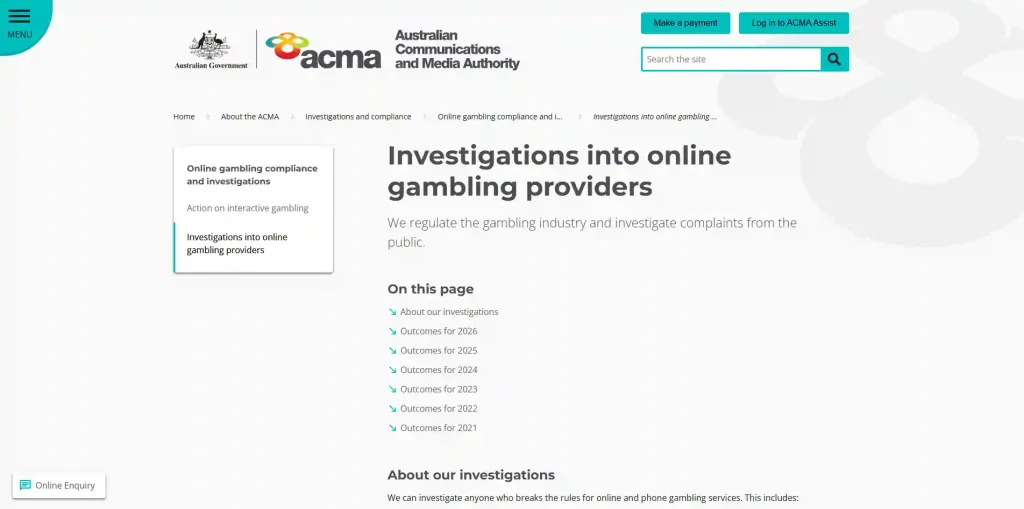
Australian law prohibits providers from offering online casino-style interactive gambling services to customers physically present in Australia. The central federal law is the Interactive Gambling Act 2001 (Cth), and the Australian Communications and Media Authority (ACMA) enforces key parts of that framework. ACMA lists King Billy Casino in its 2021 enforcement outcomes for providing a prohibited interactive gambling service with an Australian-customer link.
That legal position is about the service provider and the service being offered. It should not be rewritten as a claim that an individual Australian player commits an offence simply by visiting a casino site. It also should not be confused with Australia’s licensed online wagering market, which operates under a different category of the law and is linked to state or territory licences, the ACMA register and protections such as BetStop.
Table of Contents
- The Interactive Gambling Act draws the main legal boundary
- Online casinos and licensed wagering are not the same category
- ACMA’s role goes beyond publishing guidance
- King Billy appears in ACMA’s 2021 enforcement record
- Advertising prohibited online casino services is also restricted
- BetStop protects a different part of the market
- What the 2026 gambling reforms change
- What Australian law does not say about the individual player
- Gambling winnings and Australian tax need a narrow caveat
- How to interpret the law without mixing up the regulators
- Why the ACMA register is not a list of approved online casinos
- What King Billy’s Australian context means in practice
- The Australian distinction that matters most
- Official references and further reading
- Is King Billy Casino Legit? Trust, Reputation and Evidence
The Interactive Gambling Act draws the main legal boundary
The Interactive Gambling Act 2001 is the federal statute at the centre of Australia’s online-gambling rules. Under the Act, a prohibited interactive gambling service includes gambling services provided in the course of business to customers over the internet and related communications systems, subject to specific exclusions.
The key Australian-customer test is physical presence. The Act defines an Australian-customer link by whether customers are physically present in Australia. That matters because the legal framework is not based simply on whether a website uses Australian dollars, appears in Australian search results or has an Australian-themed page.
ACMA’s current public guidance puts the rule in plain language: providers must not offer banned online gambling services to people in Australia, and the banned categories include online casinos. Casino-style games such as online slots, roulette and blackjack fall within the type of services ACMA repeatedly identifies in its enforcement work.
Online casinos and licensed wagering are not the same category
One of the easiest mistakes to make is treating every online gambling service as if it could simply obtain the same Australian licence. The law distinguishes prohibited interactive gambling services from regulated interactive wagering services.
Licensed Australian wagering providers can offer certain betting services when they hold the required state or territory licence and comply with federal requirements. ACMA publishes a register so consumers can check whether an online wagering provider is licensed to operate in Australia. Online casino-style services are different: ACMA’s guidance lists online casinos among the banned services that providers must not offer to people in Australia.
| Service type | Australian position | What to check |
|---|---|---|
| Online casino-style games | Prohibited interactive gambling services when offered to people in Australia | ACMA guidance and enforcement records |
| Australian-licensed online wagering | Regulated service that may operate with the required Australian licence | ACMA’s licensed-provider register and state/territory licensing authority |
| Unlicensed online wagering | Cannot lawfully be provided to Australian customers | ACMA register and enforcement material |
This distinction is also why King Billy’s foreign licensing position needs its own treatment. The King Billy licence page explains the disclosed Tobique licence without presenting it as an Australian authorisation.
ACMA’s role goes beyond publishing guidance
ACMA investigates suspected breaches of the Interactive Gambling Act and publishes outcomes involving prohibited and unlicensed services. Its enforcement options include formal warnings and other regulatory action, and it can request that Australian internet service providers block access to websites found to be providing illegal gambling services.
Website blocking has become a major disruption tool. ACMA’s 2026 updates continue to report batches of illegal gambling and affiliate sites referred for ISP blocking. Blocking is an enforcement response to services found in breach; it should not be interpreted as a technical status check showing whether every related domain is reachable by every user at a particular moment.
Mirror-domain, DNS, VPN and other bypass instructions are outside the scope of explaining the legal framework and would undermine the purpose of regulatory information.
King Billy appears in ACMA’s 2021 enforcement record
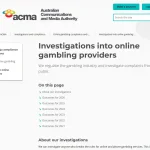
ACMA’s published investigations page lists King Billy Casino among the services in its 2021 prohibited-services outcomes. ACMA states that the relevant services were found to be providing prohibited interactive gambling services with an Australian-customer link, contrary to subsection 15(2A) of the Interactive Gambling Act.
ACMA’s 2021 reporting also shows King Billy-related domains among websites referred for blocking. In its July to September 2021 report, ACMA listed kingbillycasino.com and kingbillywin1.com in a group of blocked websites connected with illegal gambling services and alternate sites.
The correct way to use this history is precise rather than expansive. It establishes a documented Australian enforcement outcome involving King Billy in 2021. It does not prove the status of every current domain, every individual account or every transaction in 2026. For a broader assessment that combines this regulatory history with operator and account evidence, see the King Billy trust and reputation page.
Advertising prohibited online casino services is also restricted
The Australian framework does not stop at the provision of the gambling service. ACMA states that advertisements for prohibited interactive gambling services are banned in Australia, including advertising for online casino-style services.
That distinction matters. A factual discussion of a casino’s regulatory status is different from encouraging readers to sign up, offering a promotional link or framing the illegal service as an Australian gambling opportunity. The information is therefore presented without affiliate-style calls to action or access instructions.
BetStop protects a different part of the market
BetStop – the National Self-Exclusion Register – lets people exclude themselves from Australian-licensed online and phone wagering services in one process. ACMA states that licensed wagering providers covered by BetStop must close relevant betting accounts, prevent self-excluded people from placing bets or opening new accounts and stop marketing to them.
BetStop should not be described as a protection that applies to illegally provided online casino games. Its scope is Australian-licensed wagering. This matters because readers sometimes see a national responsible-gambling scheme and assume it applies to every gambling website accessible from Australia. It does not.
The same scope issue applies to the broader National Consumer Protection Framework for Online Wagering. Those safeguards are designed around licensed wagering services. They do not convert offshore online casinos into licensed Australian services and should not be presented as a protection layer for King Billy casino play.
What the 2026 gambling reforms change
Australia enacted the Interactive Gambling Amendment (Gambling Reform) Act 2026 on 26 August 2026. The reform package strengthens the federal framework, including tighter wagering-advertising controls and additional measures aimed at illegal gambling services and related avoidance behaviour.
Timing matters. ACMA states that most of the 2026 reforms commence on 1 January 2027. As of September 2026, it would therefore be inaccurate to describe the entire reform package as already fully operational. The existing prohibitions on providing online casino services to people in Australia remain important now, while the newer provisions have their own commencement timetable.
This is a useful example of why legal pages should distinguish enactment from commencement. A law can have received assent while some operative provisions are scheduled to begin later.
What Australian law does not say about the individual player
The core federal rule discussed here is directed at providers offering prohibited interactive gambling services with an Australian-customer link. ACMA’s public material explains what operators may not provide or advertise and how illegal services are investigated and disrupted.
It would be misleading to turn that provider-side rule into an unsupported statement that an ordinary individual commits an offence merely by accessing an offshore casino website. State and territory laws can add other gambling rules, and individual circumstances can differ, but the federal provider prohibition should be described in its actual scope.
The practical consumer issue is different: ACMA warns that illegal gambling services may lack important customer protections. If a dispute arises with an offshore casino, the consumer may not have the same Australian licensing and complaint protections that apply to a locally licensed wagering service.
Gambling winnings and Australian tax need a narrow caveat
For ordinary recreational gambling, Australian tax treatment is generally different from business income. ATO material states that betting and gambling wins are generally not assessable and losses are generally not deductible unless the person is carrying on a business of betting or gambling.
Whether gambling activity amounts to a business depends on the facts, including how systematic, organised and businesslike the activity is and its scale and purpose. That means a simple statement that “gambling winnings are always tax-free” would be too broad.
This tax point also does not alter the legality of the service being offered. Tax treatment and gambling-service regulation are separate questions governed by different rules.
How to interpret the law without mixing up the regulators
- ACMA: enforces key federal interactive-gambling rules, investigates prohibited and unlicensed services and maintains the public licensed-provider register.
- Federal Parliament: sets the national legal framework through the Interactive Gambling Act and amendments such as the 2026 reform Act.
- States and territories: license and regulate permitted gambling activities within their own jurisdictions, including licensed wagering providers.
- ATO: deals with taxation, including when gambling activity may amount to a business for income-tax purposes.
Keeping those roles separate avoids common category errors, such as saying ACMA issues all Australian gambling licences or using tax treatment as evidence that an online casino service is lawful to provide.
Why the ACMA register is not a list of approved online casinos
ACMA’s public register is most useful for checking licensed interactive wagering providers. It should not be read as a catalogue in which an online casino becomes permissible once its name appears. Australian law treats casino-style interactive gambling as a prohibited service category, while licensed wagering sits in a different regulatory category. Keeping that distinction clear prevents the register from being used to support a claim it was not designed to prove.
What King Billy’s Australian context means in practice
The legal facts point in one direction. Online casino-style services are prohibited from being provided to customers physically present in Australia under the Interactive Gambling Act framework. ACMA enforces that regime and has a documented 2021 enforcement outcome involving King Billy Casino. King Billy also does not appear in ACMA’s public register as an Australian-licensed interactive gambling provider.
At the same time, those facts should stay within their proper scope. They do not justify inventing criminal liability for individual players, and they do not determine unrelated product facts such as game availability or payment methods. The full King Billy review keeps the legal context separate from those product questions while still giving the Australian regulatory record appropriate weight.
The Australian distinction that matters most
For readers comparing gambling services, the most important distinction is between Australian-licensed wagering and prohibited online casino services. Licensed wagering providers operate within a framework that includes Australian licensing, the ACMA register and BetStop obligations. Offshore online casino services sit outside that licensed wagering framework and are prohibited from being offered to people physically present in Australia.
King Billy’s 2021 ACMA history places the brand directly inside that regulatory context. The most useful response is not to search for workarounds but to understand which protections and authorities actually apply, which claims the Australian regulator has recorded, and where foreign licensing ends and Australian law begins.
Official references and further reading
- ACMA – About the Interactive Gambling Act
- ACMA – Investigations into online gambling providers
- ACMA – Check if a gambling operator is legal
- ACMA – BetStop National Self-Exclusion Register
- Federal Register of Legislation – Interactive Gambling Act 2001
- Federal Register of Legislation – Interactive Gambling Amendment (Gambling Reform) Act 2026